


Moisture is one of the most important factors affecting straw pelletizing results. Wheat straw, rice straw, corn stalks, barley straw, oat straw, and other agricultural residues can all be processed into biomass pellets, but their moisture content must be properly controlled before and during pelletizing.
A straw pellet production line may contain high-quality shredders, dryers, hammer mills, pellet mills, coolers, screens, and packaging machines, yet unstable moisture can still result in poor pellet quality and inefficient production.
Too much moisture may produce soft pellets, unstable feeding, die blockage, excessive steam, and increased drying costs. Material that is too dry can also create difficulties, including poor bonding, increased dust, and unstable pellet formation.
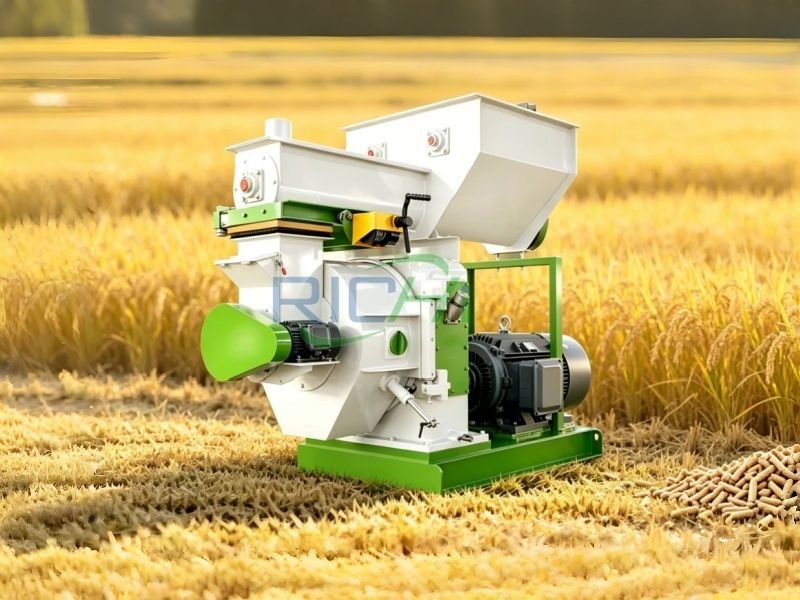
For businesses researching a straw pellet machine for sale, understanding the relationship between moisture and pelletizing is essential. The pellet mill should not be evaluated independently from the dryer, grinding system, feeding equipment, and other parts of the production line.
This article explains how moisture affects straw pelletizing results, why moisture varies in agricultural residues, how to control it, and how proper moisture management can improve pellet quality and production efficiency.
Why Moisture Matters in Straw Pelletizing
Straw is a natural fibrous biomass material.
During pelletizing, particles are compressed under considerable mechanical pressure. Friction generates heat, while the natural components of the biomass contribute to particle bonding.
Moisture affects almost every part of this process.
It influences:
- Particle flexibility
- Material flow
- Compression
- Pellet density
- Pellet durability
- Die resistance
- Motor load
- Cooling
- Storage stability
- Energy consumption
This means moisture is not simply a parameter controlled by the dryer.
It must be considered throughout the entire production process.
What Happens When Straw Contains Too Much Moisture?
High-moisture straw can create multiple problems.
Soft Pellets
Excess moisture can prevent the compressed material from forming sufficiently stable pellets.
The resulting pellets may have lower mechanical strength and may break more easily during transportation.
Poor Pellet Density
Excess moisture can interfere with effective densification.
Instead of forming a stable compact structure, the material may behave more like a wet mass.
Die Blockage
High moisture can make straw sticky.
This may increase resistance inside the die and contribute to blockage.
A blocked die can interrupt production and increase the workload on the pellet mill.
Increased Drying Costs
If incoming straw is excessively wet, more thermal energy is required to bring it into a suitable condition for pelletizing.
This can significantly increase operating costs in large-scale production.
Difficult Cooling
Hot, moist pellets can require additional cooling.
If the cooling process is insufficient, pellets may remain warm and unstable before packaging.
Storage Problems
Moist pellets are more vulnerable to quality deterioration during storage.
They may absorb or retain moisture and lose mechanical stability.
What Happens When Straw Is Too Dry?
It is easy to assume that drier material is always better.
This is not necessarily true.
Excessively dry straw can also create problems.
Poor Pellet Binding
Moisture contributes to the physical behavior of particles during compression.
If the material is too dry, it may not form sufficiently stable pellets under certain operating conditions.
Increased Dust
Very dry biomass can generate more dust during grinding, conveying, and pelletizing.
Unstable Pellet Formation
The material may pass through the die without forming pellets with the desired strength and density.
Higher Material Loss
Increased fines can reduce the percentage of finished pellets recovered after screening.
Higher Dust Collection Requirements
More airborne particles may increase the workload of the dust collection system.
Therefore, the goal should be controlled moisture, not maximum dryness.
What Is the Ideal Moisture Content for Straw Pelletizing?
There is no single moisture value that works perfectly for every type of straw, pellet mill, and production line.
The appropriate operating range depends on:
- Straw species
- Initial moisture
- Particle size
- Fiber structure
- Pellet diameter
- Die compression ratio
- Pellet mill design
- Production capacity
- Conditioning method
- Cooling system
In many biomass pelletizing applications, a moisture range around 10% to 15% is often used as a practical starting point, but the optimum value should be determined through raw material testing and actual machine trials.
The ideal moisture condition is the one that provides stable pellet formation, acceptable durability, reasonable energy consumption, and reliable machine operation.
How Straw Moisture Changes During the Production Process
Moisture does not remain constant from raw material receiving to finished pellet storage.
A typical process may look like this:
Raw Straw → Shredding → Drying → Grinding → Pelletizing → Cooling → Screening → Packaging
Each stage can affect moisture.
Raw Straw
Freshly harvested straw may contain relatively high moisture.
Stored straw may become drier, but outdoor storage can also expose it to rain and humidity.
Drying
The industrial rotary dryer machine removes excess moisture.
Grinding
Grinding can alter material temperature and expose more surface area, which may influence moisture distribution.
Pelletizing
Compression generates heat.
This can cause some moisture to evaporate or redistribute inside the material.(Learn more: https://richipelletizer.com/straw-pellet-machine-for-sale/)
Cooling
Cooling removes heat and can also reduce residual moisture.
Storage
Finished pellets can absorb moisture from humid air if storage conditions are poor.
This is why moisture should be monitored throughout the process.
How Initial Straw Moisture Affects Dryer Selection
The initial moisture content directly affects dryer capacity.
Suppose two plants have the same pellet mill capacity.
Plant A receives relatively dry straw.
Plant B receives straw with significantly higher moisture.
Plant B will require a larger drying capacity or longer drying time to provide the pellet mill with the same quantity of suitably conditioned material.
Therefore, dryer selection should be based on actual raw material moisture rather than simply the pellet mill’s rated output.
Important dryer design parameters include:
- Initial moisture
- Target moisture
- Material throughput
- Heat source
- Ambient conditions
- Particle size
- Required operating hours
How to Measure Straw Moisture
Moisture should be measured using representative samples.
A sample taken from only one location may not accurately represent the entire batch.
Straw moisture can vary between:
- Different bales
- Different fields
- Different crop varieties
- Different storage locations
- Different harvesting periods
A moisture meter can provide rapid measurements, while laboratory methods can provide more detailed analysis.
For commercial production, regular moisture monitoring can help operators identify changes before they cause major production problems.
How Moisture Affects Pellet Density
Pellet density is an important physical characteristic.
During compression, straw particles are forced into the die holes.
Moisture affects how easily the particles deform and compact.
If moisture is too high, the material may resist stable densification.
If moisture is too low, the particles may not form the desired compact structure.
The final density is also affected by:
- Particle size
- Compression ratio
- Pellet diameter
- Roller pressure
- Raw material composition
- Operating conditions
Therefore, moisture should always be considered together with these other variables.
How Moisture Affects Pellet Durability
Pellet durability describes how well pellets resist breaking during handling and transportation.
Poor durability can result in more fines.
Moisture has an important influence on this characteristic.
When the moisture condition is appropriate, particles can form stronger bonds during compression.
If moisture is far outside the suitable range, the pellets may become weak.
However, durability is not determined by moisture alone.
It also depends on:
- Raw material composition
- Grinding quality
- Die compression
- Pellet mill operation
- Cooling
- Handling
How Moisture Affects Pellet Mill Capacity
Moisture can affect the production capacity of a straw pellet machine.
When material is too wet, the pellet mill may experience increased resistance.
The motor may draw more power while actual output decreases.
When material is too dry, pellet formation may become unstable, resulting in more fines and lower effective production.
Therefore, the highest nominal feed rate does not always provide the highest useful production.
A stable moisture condition can help the machine operate closer to its practical production range.
How Moisture Affects Electricity Consumption
Moisture has an indirect but important effect on energy consumption.
Drying Energy
The wetter the straw, the more energy is required to remove water.
This can make the dryer one of the major energy consumers in a biomass pellet plant.
Pelletizing Energy
Unsuitable moisture can increase resistance inside the pellet mill.
This may increase motor load and electricity consumption.
Grinding Energy
Moisture can also influence grinding behavior.
Very wet biomass may be difficult to grind efficiently, while excessively dry material may generate more dust.
Therefore, controlling moisture can help optimize total energy consumption rather than only the pellet mill’s electricity usage.
How Moisture Affects Die Performance
The die is a key component of the pellet mill.
Material passes through die holes under pressure.
If the material contains too much moisture, it may become sticky and increase resistance.
This can contribute to:
- Die blockage
- Increased pressure
- Reduced output
- Higher motor load
- Faster wear
If the material is too dry, the machine may also experience unstable compression.
Therefore, stable moisture helps maintain more predictable die performance.
How Moisture Affects Roller Wear
The rollers compress straw against the die.
Unsuitable moisture conditions can increase mechanical resistance.
When material is too wet, additional pressure may be required to force it through the die.
This can increase the load on the roller and drive system.
Contamination with soil and sand can make the situation worse because abrasive particles accelerate wear.
Regular maintenance and proper raw material cleaning are therefore important in addition to moisture control.
Moisture and Straw Particle Size Work Together
Moisture cannot be optimized independently from particle size.
Consider two batches of straw with the same moisture content.
If one batch contains very long fibers while the other has been properly ground, they may behave differently inside the pellet mill.
Particle size influences:
- Surface area
- Material flow
- Compression
- Heat transfer
- Pellet formation
The ideal process therefore balances both moisture and particle size.
Moisture Control During Straw Drying
A properly designed drying process should remove enough moisture without wasting thermal energy.
Use Stable Feeding
The dryer should receive a relatively consistent amount of straw.
Sudden changes in feed rate can result in uneven drying.
Control Drying Conditions
Drying temperature and residence time should be adjusted according to the material.
Avoid Over-Drying
Removing unnecessary moisture increases energy consumption.
Monitor the Outlet Material
The moisture of dried straw should be checked regularly.
Can Steam Be Used to Control Moisture?
Steam conditioning may be used in some pelletizing processes.
Steam can increase temperature and introduce moisture into the material.
For some biomass materials, this can improve conditioning before compression.
However, steam is not automatically required for every straw pellet plant.
The decision depends on:
- Straw characteristics
- Existing moisture
- Pellet mill design
- Desired pellet quality
- Production capacity
- Process configuration
The amount of steam must also be carefully controlled because excessive moisture can have the opposite effect.
Moisture Control Before Pelletizing
The material entering the pellet mill should have a relatively stable condition.
Before pelletizing, operators can check:
- Moisture content
- Particle size
- Fiber length
- Material temperature
- Contamination
- Feeding stability
If moisture changes significantly from one batch to another, the pellet mill may require frequent adjustments.
This makes automated moisture monitoring valuable for large commercial plants.
Moisture and Pellet Cooling
Cooling is particularly important because pelletizing generates heat.
Fresh pellets can leave the pellet mill at a substantially higher temperature than the surrounding environment.
The cooler removes this heat and helps stabilize the pellets.
If pellets are not adequately cooled, moisture may remain trapped inside the product.
When hot pellets are immediately packaged, condensation can occur as the product temperature changes.
This can negatively affect storage stability.
Moisture and Pellet Storage
Pellet quality can deteriorate if the finished product is exposed to high humidity.
Biomass pellets are hygroscopic, meaning they can absorb moisture from the surrounding environment.
During storage, excessive moisture can cause:
- Pellet swelling
- Reduced hardness
- Increased fines
- Product degradation
- Handling problems
Finished pellets should therefore be stored in a dry and protected environment.
Storage facilities should also prevent direct contact with rain and groundwater.
How to Prevent Moisture Problems in Straw Pellet Production
Several practical measures can help.
Test Incoming Straw
Measure moisture before processing.
Separate Different Raw Materials
If straw from different sources has significantly different moisture levels, mixing them without control can make the process unstable.
Optimize Dryer Operation
Match dryer performance to actual moisture conditions.
Monitor Moisture After Drying
Do not assume the dryer always produces identical material.
Avoid Long-Term Outdoor Exposure
Protect raw straw from rain and excessive humidity.
Control Cooling
Cool finished pellets before packaging.
Protect Finished Products
Use appropriate packaging and dry storage.
How to Choose Equipment for Moisture Control
Moisture management should be considered when selecting every major machine.
Straw Dryer
The dryer should have sufficient capacity for the expected moisture removal.
Hammer Mill
The grinder should be suitable for the prepared straw condition.
Straw Pellet Machine
The pellet mill should match the moisture range and material characteristics.
Cooler
The cooler should have enough capacity to stabilize fresh pellets.
Storage System
The storage facility should protect both raw materials and finished pellets from excessive moisture.
What to Consider When Buying a Straw Pellet Machine for Sale
When evaluating a straw pellet machine for sale, buyers should look beyond the machine’s basic specifications.
Important questions include:
What Straw Will Be Processed?
Wheat straw, rice straw, and corn stalks may require different processing conditions.
What Is the Incoming Moisture?
This determines whether drying equipment is necessary and how large it should be.
What Is the Target Capacity?
Production capacity should be based on actual raw material conditions.
What Pellet Diameter Is Required?
The desired diameter determines die selection.
What Is the Required Pellet Quality?
Fuel specifications influence compression and cooling requirements.
What Is the Complete Line Configuration?
A pellet mill should work together with shredders, dryers, grinders, feeders, coolers, screens, and packaging machines.
What Maintenance Is Required?
Wear components such as dies and rollers should be accessible for inspection and replacement.
(click reference: RICHI Pelletizer )
Why Complete Line Design Matters
Moisture control demonstrates why a complete production line is often more important than purchasing a standalone machine.
For example, if the straw pellet machine has a capacity of several tons per hour but the dryer cannot prepare enough material at the required moisture level, the pellet mill cannot reach its practical capacity.
Likewise, if the cooler cannot handle the pellet mill output, production will be restricted downstream.
A balanced line may include:
Straw Receiving
↓
Cleaning
↓
Bale Breaking
↓
Shredding
↓
Drying
↓
Grinding
↓
Moisture Adjustment
↓
Pelletizing
↓
Cooling
↓
Screening
↓
Packaging
The capacity of each section should be coordinated.
How to Troubleshoot Moisture-Related Pellet Problems
Problem 1: Pellets Are Too Soft
Check:
- Moisture
- Die compression ratio
- Particle size
- Roller condition
- Cooling efficiency
Problem 2: Die Frequently Blocks
Check:
- Excessive moisture
- Long fibers
- Particle size
- Feeding rate
- Die condition
Problem 3: Excessive Fines
Check:
- Moisture
- Pellet density
- Die condition
- Cooling
- Screening
- Material handling
Problem 4: High Electricity Consumption
Check:
- Dryer efficiency
- Grinding size
- Material moisture
- Die resistance
- Roller and die wear
- Feeding rate
Problem 5: Pellets Become Soft During Storage
Check:
- Final moisture
- Cooling
- Packaging
- Warehouse humidity
- Exposure to rain or groundwater
A Practical Moisture Management Strategy
A good straw pellet plant can establish moisture control at several checkpoints.
Checkpoint 1: Raw Material Receiving
Measure the moisture of incoming straw.
Checkpoint 2: After Drying
Confirm that moisture has reached the desired processing condition.
Checkpoint 3: Before Pelletizing
Check whether the material remains stable after grinding and conditioning.
Checkpoint 4: After Cooling
Evaluate the temperature and moisture condition of finished pellets.
Checkpoint 5: Storage
Monitor warehouse conditions and protect the product from external moisture.
This multi-stage approach is more reliable than checking moisture only once.
Frequently Asked Questions
Does wet straw need to be dried before pelletizing?
Usually, if the incoming straw contains excessive moisture, drying is required to bring it into a suitable condition for pelletizing. The exact requirement depends on the straw and pellet mill.
Is drier straw always better for pellet production?
No. Excessive drying can increase dust and may negatively affect pellet formation. The objective is an appropriate moisture condition rather than maximum dryness.
Can different types of straw be mixed?
Yes, different agricultural residues can potentially be mixed, but their moisture, particle size, and pelletizing behavior should be evaluated first.
Does moisture affect pellet durability?
Yes. Moisture influences particle bonding and compression, although durability also depends on raw material, grinding, die design, and cooling.
Can moisture cause die blockage?
Yes. Excessively wet or sticky material can increase resistance and contribute to die blockage.
Does moisture affect pellet mill capacity?
Yes. Unsuitable moisture can reduce practical production capacity and increase energy consumption.
Conclusion
Moisture is one of the most important factors affecting straw pelletizing results. It influences pellet formation, density, durability, production capacity, energy consumption, die performance, cooling, and storage stability.
Too much moisture can produce soft pellets, increase drying costs, cause unstable feeding, and contribute to die blockage. Excessively dry material can increase dust generation and may also lead to unstable pellet formation.
For this reason, moisture should be controlled throughout the entire production process.
The typical strategy is:
Test the raw straw → Dry when necessary → Control particle size → Check moisture before pelletizing → Maintain stable feeding → Pelletize under suitable conditions → Cool properly → Protect finished pellets during storage
When searching for a straw pellet machine for sale, buyers should therefore evaluate the entire production system rather than looking only at the pellet mill itself. The dryer, grinder, feeding system, pellet mill, cooler, screen, and packaging equipment should be properly matched.
A successful straw pellet plant is built around stable raw material conditions. By controlling moisture together with particle size, fiber length, die compression, feeding, cooling, and storage, producers can achieve more consistent pellets, improve equipment stability, reduce unnecessary energy consumption, and make better use of agricultural residues as biomass fuel.