Starting a fish feed plant requires more preparation than simply choosing production equipment. Before construction begins, investors need to understand the target market, raw materials, feed formulas, production capacity, factory layout, utilities, labor requirements, and future expansion plans.
A well-planned project can reduce unnecessary investment and make daily production easier to manage. On the other hand, skipping the planning stage may create bottlenecks that become expensive to fix after installation.
This is particularly important for floating fish feed production. The final feed quality depends on several connected processes, including grinding, mixing, conditioning, extrusion, drying, cooling, screening, and packaging.
Therefore, equipment selection should come after the basic production requirements have been established.
Start With the Target Fish Species
The first question is not which machine to buy. It is what type of fish feed the plant will produce.
Different fish species have different nutritional requirements and feeding habits. Fish size also changes during the growth cycle, so the required pellet diameter may change over time.
For example, juvenile fish generally require smaller pellets than mature fish. Some farms may also produce several formulas for different growth stages.
This affects the equipment configuration because pellet size, formula composition, moisture content, and extrusion conditions can influence production performance.
Before discussing equipment with a supplier, it is useful to prepare basic information about the target fish species and expected products.
This gives the supplier a clearer understanding of what the production line needs to achieve.
Estimate the Required Production Capacity
Production capacity should be based on actual feed demand.
A small fish farm may only need a few hundred kilograms of feed per hour. A commercial producer supplying several farms may need several tons per hour.
The expected working schedule also matters.
Suppose a plant operates eight hours per day. A production capacity of 1 ton per hour could theoretically provide around 8 tons of feed per operating day. However, actual daily output will be lower if the plant needs time for cleaning, formula changes, maintenance, and equipment adjustment.
Therefore, buyers should distinguish between theoretical hourly output and practical daily production.
It is usually better to select equipment based on realistic operating conditions rather than the maximum number shown in a catalog.
Check the Local Raw Material Supply
Raw material availability can have a major impact on feed production costs.
Common fish feed ingredients may include corn, wheat, soybean meal, fish meal, rice bran, wheat bran, vegetable protein sources, oils, vitamins, and minerals.
Not every region has the same supply conditions.
Some ingredients may be locally available throughout the year, while others may need to be transported from another region or imported.
Before building a plant, investors should compare local suppliers, seasonal prices, transportation costs, storage requirements, and ingredient quality.
The feed formula may also need to be adjusted according to local raw material availability.
A formula that looks economical on paper may become expensive if most of its ingredients have high transportation costs.
Consider Raw Material Storage
Raw materials need suitable storage conditions before entering production.
Moisture is one of the main concerns.
High-moisture materials can deteriorate during storage and may also affect grinding and extrusion performance.
Storage areas should therefore protect materials from rain, excessive humidity, contamination, and pests.
The required storage capacity depends on the plant’s production schedule and purchasing strategy.
A factory that purchases raw materials in large quantities may need several days or weeks of storage capacity. A small plant with frequent local deliveries may require less storage space.
Storage should also be organized so that older materials can be used before newly received materials whenever appropriate.
Why Is Grinding Necessary?
Grinding prepares ingredients for more consistent processing.
Large particles can make mixing more difficult and may affect the stability of the extrusion process.
A hammer mill is commonly used in feed production because it can process various grains and agricultural materials.
The required particle size depends on the feed formula and final pellet specifications.
Very small fish may require smaller pellets, which often means finer raw material processing.
However, excessive grinding can increase electricity consumption without providing a proportional improvement in feed quality.
The practical goal is to achieve a particle size that supports good mixing and stable extrusion while keeping energy consumption reasonable.
Why Does Mixing Affect Feed Quality?
After grinding, ingredients need to be mixed evenly.
A feed formula may contain ingredients with different particle sizes, densities, and moisture levels. Without sufficient mixing, the final mixture may not be uniform.
This is particularly important when the formula contains small quantities of vitamins, minerals, or functional additives.
If these components are not distributed evenly, different portions of the same production batch may have different nutritional characteristics.
A suitable mixer should provide consistent blending within an appropriate mixing time.
For larger plants, automatic batching systems can also improve ingredient weighing accuracy and reduce manual handling.
What Happens During Extrusion?
Extrusion is an important stage in floating fish feed production.
During the process, the prepared feed mixture is subjected to mechanical pressure, heat, moisture, and friction.
These conditions change the physical structure of the feed material.
When the material leaves the die, the sudden pressure reduction allows moisture to expand into steam. This can create a porous structure inside the pellet and reduce its bulk density.
As a result, properly processed pellets can float on the surface of water.
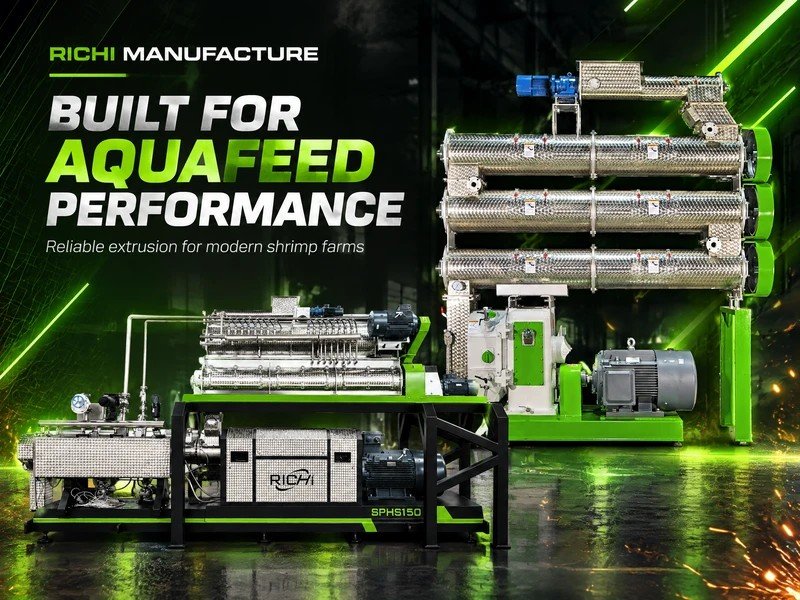
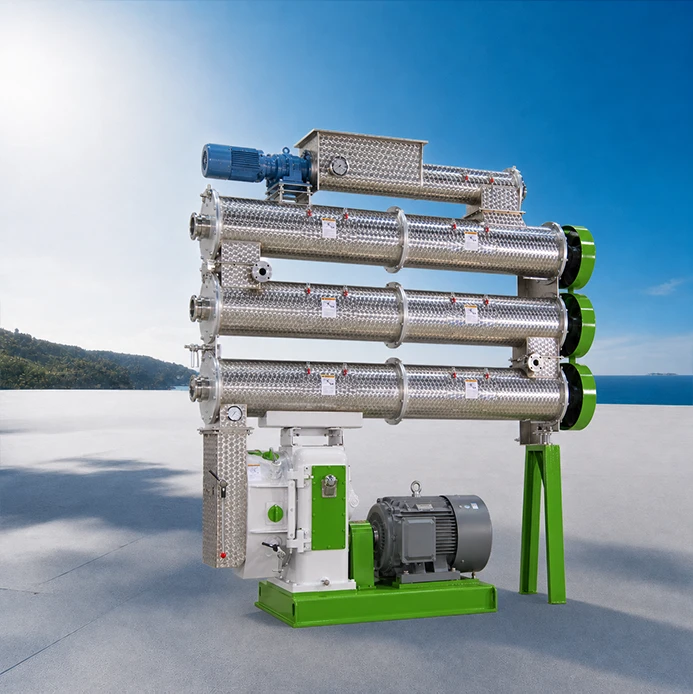
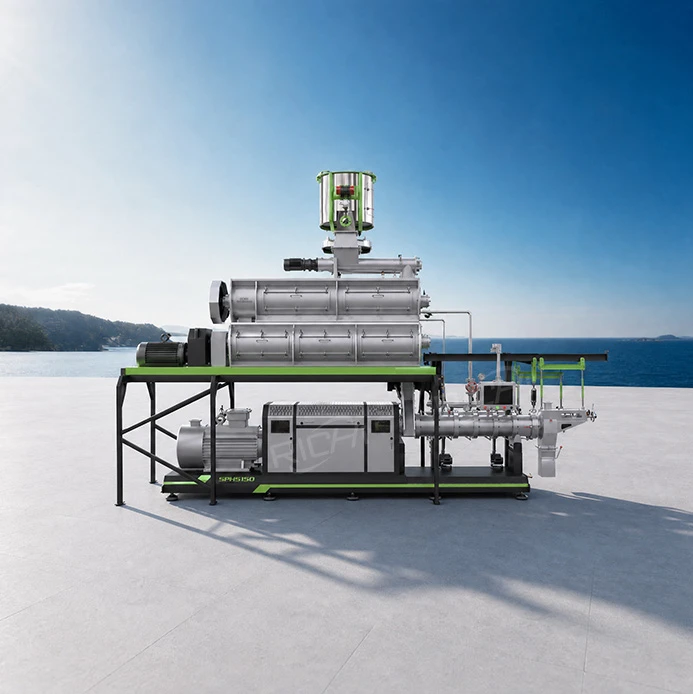
The extruder machine for fish feed therefore plays an important role in controlling the physical characteristics of floating pellets.
However, the extruder should not be considered separately from the rest of the production line. Its performance depends on the formula, moisture content, particle size, operating conditions, and downstream drying capacity.
What Determines Pellet Size?
Pellet diameter is mainly influenced by the die opening and cutting system.
Different fish species and growth stages may require different pellet sizes.
A commercial feed plant may therefore need to produce several diameters instead of only one product.
This should be considered when selecting extrusion equipment.
Changing pellet specifications may require adjustments to the die and cutter. The time required for product changeover can affect overall production efficiency.
For a plant producing several feed types every day, quick and convenient adjustment can be valuable.
For a farm producing one formula continuously, the equipment configuration can be simpler.
Does the Feed Need Conditioning?
Conditioning prepares the feed mixture before or during extrusion.
Water and heat can help create more suitable processing conditions and improve the consistency of the material entering the extrusion chamber.
The exact conditioning method depends on the equipment configuration and feed formula.
Some formulas may require different moisture conditions from others.
The operator should therefore monitor the material condition rather than using one fixed setting for every product.
Stable conditioning can help reduce fluctuations in extrusion performance.
It may also make it easier to maintain consistent pellet density and physical quality.
Why Does Extruded Feed Need Drying?
Freshly extruded feed usually contains more moisture than the final product should have.
Drying reduces this excess moisture and improves storage stability.
The drying process needs to be matched to the extrusion output.
If the dryer is too small, wet pellets can accumulate between extrusion and drying. This creates a production bottleneck.
If the dryer is much larger than necessary, the project may carry unnecessary equipment and energy costs.
Drying temperature and residence time also need to be controlled.
Over-drying can waste energy, while insufficient drying may leave too much moisture in the finished feed.
The target should be a stable final moisture level suitable for storage and packaging.
Why Is Cooling Necessary?
After drying, the pellets should be cooled before packaging.
The cooling process reduces product temperature and helps stabilize the feed.
Packing hot material directly can increase the risk of condensation inside bags when the product temperature changes.
A suitable cooling system can also improve the handling characteristics of the finished pellets.
In a continuous production line, cooling equipment should be matched with the dryer and extrusion capacity.
This allows material to move smoothly through the production process without creating unnecessary accumulation.
What Does Screening Do?
Screening removes fines and particles outside the desired product specification.
Some fines are naturally generated during extrusion and subsequent conveying.
Removing them before packaging can improve the appearance and consistency of the finished feed.
The screening system should be selected according to the pellet size and production capacity.
If a plant produces several pellet sizes, the screening configuration may need to accommodate different products.
In some production systems, recovered fines can be returned to the processing line rather than being discarded.
This can improve material utilization.
How Should the Factory Layout Be Planned?
The factory layout should follow the material flow.
A typical process may look like:
Raw material receiving → storage → grinding → batching → mixing → extrusion → drying → cooling → screening → packaging → finished product storage
This arrangement reduces unnecessary material movement.
It also makes it easier for operators to understand the production process.
Equipment requiring regular maintenance should have enough surrounding space.
Motors, bearings, gearboxes, electrical components, dies, cutters, and other wear parts should remain accessible.
The layout should also consider dust control around grinding and conveying areas.
For larger plants, vertical conveying equipment can reduce the amount of floor space required. Smaller facilities may use a simpler horizontal arrangement.
There is no single layout that works for every project. The design should be based on capacity, building dimensions, equipment configuration, and future expansion plans.
How Much Automation Does a Fish Feed Plant Need?
Automation requirements depend on production capacity and labor costs.
A small plant may use manual feeding and semi-automatic weighing systems.
As production increases, automatic batching and centralized control can become more valuable.
Automation can improve weighing accuracy and reduce repetitive manual work.
However, adding automation also increases the initial investment.
Therefore, buyers should calculate whether the expected labor savings and production improvements justify the additional cost.
A good solution is not necessarily the most automated solution. It is the one that provides the right balance between investment, labor, production stability, and future expansion.
What About Packaging?
Packaging is the final stage before finished feed enters the warehouse.
The package size should reflect the target market.
Small retail bags may be suitable for individual farmers and distributors, while larger bags may be more practical for commercial farms.
The packaging system should also provide consistent weighing.
If the plant sells large quantities of feed, automatic weighing and bagging can reduce labor requirements.
The finished product should be protected from moisture during storage and transportation.
Packaging design is therefore not simply a marketing decision. It is also part of feed quality management.
How Can Production Costs Be Controlled?
Production costs come from several sources.
Raw materials are usually one of the largest expenses. Electricity, labor, packaging, maintenance, transportation, and equipment depreciation also contribute to the total cost.
Energy consumption deserves particular attention because grinding, extrusion, drying, and conveying all require power.
A plant should therefore avoid selecting oversized equipment that operates far below its efficient working range.
Maintenance costs should also be considered.
Wear parts need periodic inspection and replacement. Easy access to these components can reduce downtime.
Reducing unnecessary material handling can further improve efficiency.
The best way to control costs is to look at the entire production process rather than focusing on one machine’s purchase price.
Should You Build a Feed Plant for Your Own Farm?
For large aquaculture farms, producing feed internally can provide greater control over feed formulas and production schedules.
The farm can adjust ingredients according to fish growth stages and local raw material availability.
It may also reduce dependence on commercial feed suppliers.
However, internal production requires additional management.
The farm needs to purchase raw materials, maintain equipment, monitor formulas, manage operators, and control finished feed quality.
For a small farm with limited feed consumption, purchasing commercial feed may still be more economical.
The decision should therefore be based on actual annual feed demand and the expected return on the equipment investment.
What Should You Ask an Equipment Supplier?
Before purchasing equipment, buyers should prepare several questions.
First, ask about actual capacity under the intended formula.
Second, confirm the pellet diameters that can be produced.
Third, ask about moisture requirements and extrusion conditions.
Fourth, understand which machines are required before and after extrusion.
Finally, ask about installation, operator training, spare parts, maintenance, and technical assistance.
These questions can help buyers compare suppliers based on the complete project rather than simply comparing machine prices.
A supplier with experience in fish feed production can also help identify potential bottlenecks before construction begins.
Why Is Supplier Experience Important?
Feed production equipment is part of a larger process.
A machine may have good specifications, but the final production result still depends on how it works with grinding, mixing, drying, cooling, conveying, and packaging equipment.
This is why supplier experience can be valuable.
An experienced supplier can evaluate the raw materials, target capacity, pellet size, factory conditions, and automation requirements before recommending equipment.
For international projects, technical communication is equally important.
Clear drawings, equipment specifications, installation instructions, spare parts information, and after-sales support can reduce difficulties during installation and commissioning.
Companies comparing complete feed production solutions can also work with Richi Pellet Machinery to evaluate equipment configurations according to their production requirements.
What Should Be Included in the Project Plan?
Before construction, it is useful to prepare a basic project plan.
The plan can include:
- Target production capacity
- Feed formulas
- Target fish species
- Pellet diameters
- Raw material sources
- Raw material storage requirements
- Factory dimensions
- Electricity supply
- Water supply
- Equipment configuration
- Packaging specifications
- Labor requirements
- Finished product storage
- Future expansion plans
This information provides a practical foundation for equipment selection.
It also allows the supplier to estimate the required equipment capacity and factory layout more accurately.
If the project requires customized equipment selection, production-line design, installation guidance, or technical assistance, why not try here and discuss the project requirements with the supplier before making a final decision.
Final Thoughts
Building a fish feed plant is a long-term investment, so the planning stage deserves careful attention.
The most important decisions should be made before equipment arrives at the factory. Investors need to understand their target market, raw materials, feed formulas, production capacity, pellet sizes, factory conditions, and future development plans.
The extrusion process is especially important for floating feed because it influences pellet expansion, density, and physical structure. However, extrusion is only one part of the complete production system.
Grinding, mixing, conditioning, drying, cooling, screening, and packaging must all work together.
A well-designed production line can reduce material handling, improve production consistency, and make future expansion easier.
Instead of choosing equipment based only on purchase price, buyers should evaluate the complete process and the long-term operating requirements. This approach can help build a fish feed production project that is easier to operate and better suited to the actual needs of the business.