



Wood pellets are widely discussed as a practical solid fuel made from renewable biomass. But producing consistent pellets is not simply a matter of pressing sawdust through a machine. The quality of the final product depends on several connected factors, including the type of raw material, particle size, moisture content, feeding method, compression, cooling, and screening.
For businesses considering a biofuel pellet production line, understanding these basic relationships can make equipment selection and process planning much easier. A well-designed line does not necessarily need the most complicated configuration. Instead, each machine should match the characteristics of the raw material and the intended production capacity.
This article looks at the process from a practical perspective and answers some of the common questions that arise when planning a wood pellet project.
What Raw Materials Can Be Used to Make Wood Pellets?
Wood processing residues are among the most common raw materials for biomass fuel pellets. Sawdust, wood chips, branches, and other suitable wood residues can be processed into dense pellets after appropriate preparation.
The choice of material matters because different forms of biomass behave differently during processing. Sawdust is already relatively fine, while logs or larger wood pieces require additional size reduction before they can enter the pelletizing stage.
Agricultural residues such as straw, grass, and other fibrous materials can also be pelletized, but they should not automatically be treated in exactly the same way as wood. Their bulk density, fiber structure, moisture requirements, and feeding characteristics can be different.
For this reason, the first question for a new project should not simply be “Which pellet machine should I buy?” It should be “What raw materials will be available throughout the year, and what condition will they be in?”
Is Sawdust Better Than Wood Chips for Pellet Production?
Sawdust is convenient because it usually requires less mechanical preparation than large wood pieces. However, that does not mean every type of sawdust can be fed directly into a pellet mill.
Fresh sawdust may contain too much moisture, while very dry material may generate excessive dust and behave differently during compression. The material can also vary depending on the tree species, processing method, storage conditions, and amount of bark or other impurities.
Wood chips present another challenge. They generally need to be reduced to a smaller and more uniform particle size before pelletizing. According to the training material, the typical wood pellet process includes chipping and crushing, with the material reduced to approximately 3–5 mm before drying and pelletizing.
When comparing a sawdust pellet machine for sale, it is therefore important to look beyond the pellet mill itself. The upstream crushing and drying systems can have a significant effect on the overall performance of the plant.
How Important Is Moisture Content?
Moisture is one of the most important variables in biomass pellet production.
If the raw material is too wet, it may be difficult to form stable pellets, while excessive moisture can increase the load on downstream equipment and make storage more difficult. On the other hand, material that is excessively dry may not bind effectively during compression.
The supplied technical material gives a typical moisture range of approximately 13–18% for wood materials before pelletizing.
This is why a dryer is normally an important part of a wood pellet project. Instead of treating drying as a separate step, it is better to consider it as part of the overall material preparation system.
The actual target should be determined according to the raw material, local conditions, pellet mill requirements, and final product specifications. A moisture meter and regular sampling can help operators monitor whether the material entering the pellet mill remains within the appropriate range.
Why Does Particle Size Matter?
Particle size affects feeding, compression, pellet appearance, and energy consumption.
Large particles can make the material difficult to feed evenly and may reduce the consistency of the finished pellets. Excessively fine material, meanwhile, can increase dust and may not always provide the desired flow characteristics.
A typical wood processing route starts with larger wood pieces, followed by chipping and crushing. The training material identifies approximately 3–5 mm as a typical particle size before drying in the wood pellet process.
In actual projects, the appropriate particle size should be confirmed through raw-material testing rather than applied as a universal number. The ideal setting can vary with the pellet diameter, raw material structure, and equipment design.
What Is the Typical Wood Pellet Production Process?
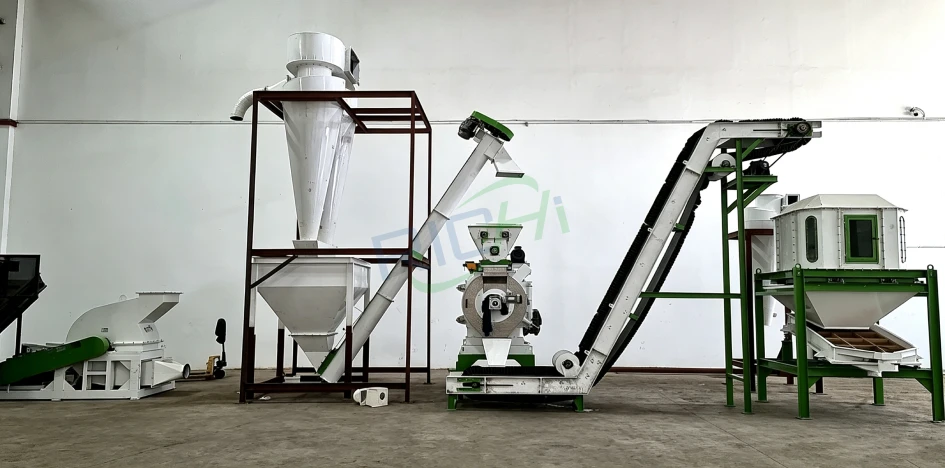
A relatively straightforward wood pellet process can be described as:
Raw wood → Chipping → Crushing → Drying → Pelletizing → Cooling → Screening → Packaging
Each stage performs a different function.
First, large wood materials are reduced in size. The crushing stage creates a more uniform material that can be processed more consistently.
Next comes drying. The purpose is to bring the moisture content into a suitable range for pelletizing.
The prepared material is then fed into the pellet mill. Unlike feed pellet production, wood pellet production generally does not rely on steam conditioning as a standard requirement. The training material specifically distinguishes biomass pellet production from conventional animal feed pelletizing in this respect.
After pelletizing, the hot pellets need to be cooled. Screening separates acceptable pellets from fines and undersized material. Depending on the production system, fines can be returned to the process rather than being treated as waste.
Finally, the finished pellets are weighed and packaged for transportation or storage.
Does Wood Pellet Production Need a Steam Conditioner?
This is a common point of confusion because feed pellet mills often use steam conditioning.
For conventional wood biomass pellets, steam conditioning is generally not a standard requirement in the same way it is for animal feed. The training material describes wood pellet production as a process based mainly on drying and mechanical pelletizing, rather than steam conditioning.
This difference is important when designing a production line. A wood pellet plant should not simply copy the process configuration of a livestock feed plant.
Instead, attention should be placed on raw-material handling, forced or stable feeding, moisture adjustment, drying efficiency, wear resistance, and the pellet mill’s ability to handle fibrous biomass.
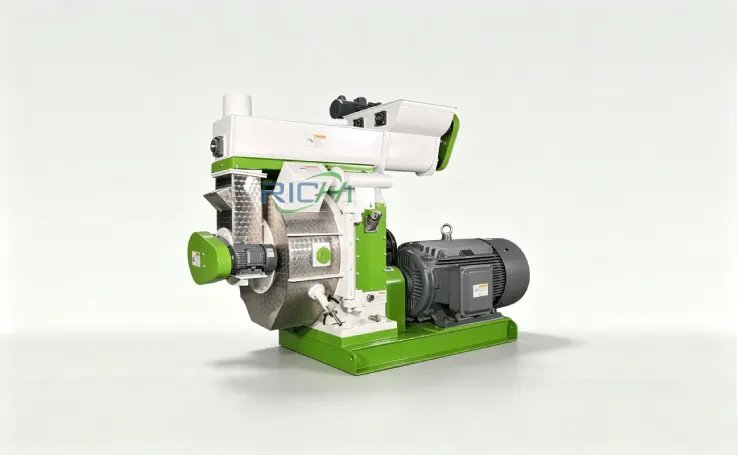
What Kind of Pellet Mill Is Suitable for Biomass?
Biomass pellet mills differ from many animal feed pellet mills in several important respects.
Wood materials are fibrous and abrasive. The supplied training material describes biomass pellet mills as using wear-resistant alloy steel dies, including 42CrMo material, together with relatively low-speed, high-torque drive characteristics.
The compression ratio is also different. The material gives a typical range of approximately 1:6–1:12 for wood materials. A higher compression ratio generally produces denser and harder pellets, but excessive compression can also increase mechanical resistance and energy consumption.
Therefore, die selection should be based on the raw material and required pellet specifications rather than simply choosing the largest available compression ratio. Related Post: https://commercialpelletmill.com/biomass-pellet-machine/
How Does Cooling Improve Pellet Quality?
Pellets leaving the pellet mill are relatively hot and may still contain internal heat and moisture.
Cooling allows the pellets to reach a more suitable condition for screening, handling, and storage. If hot pellets are packaged too quickly, condensation or other storage problems may occur.
A cooling system also contributes to the physical stability of the product. Once cooled, the pellets can be screened more effectively, and fines can be separated before packaging.
For larger plants, the cooling stage should be considered together with airflow, residence time, pellet temperature, and material throughput.
Why Is Screening Necessary After Pelletizing?
Not every particle leaving a pellet mill will have exactly the same size.
Some pellets may break during transportation through the system, while small particles and fines may remain after pelletizing. Screening separates these materials from the finished product.
The training material describes the post-pelletizing sequence for biomass as cooling followed by screening and packaging.
Screening is therefore not simply a cosmetic step. It helps establish a more consistent final product and can reduce the amount of fines entering storage or transportation.
In a continuous production system, separated fines may also be returned to an appropriate point in the process, depending on the plant design.
Should a Pellet Plant Include a Dryer?
For wood pellets, drying is normally an essential process.
This is one of the clearest differences between wood biomass pellet production and conventional feed pellet production. The training material states that wood materials generally need to be dried to approximately 13–18% moisture before pelletizing, while feed pellet production does not normally require the same drying step.
The dryer should therefore be selected according to the incoming moisture content and required production capacity.
For example, a project using relatively dry sawdust may need less drying capacity than a project using freshly processed wood chips with a much higher moisture level. Calculating the water evaporation requirement before selecting the dryer can prevent both under-sizing and unnecessary investment.
How Should a New Project Choose Production Capacity?
Production capacity should be connected to raw-material availability rather than selected only according to the desired sales volume.
A plant designed for high output requires enough raw material, storage capacity, drying capacity, conveying capability, electrical infrastructure, and finished-product storage to support continuous operation.
If the pellet mill is rated for a certain throughput but the dryer or crusher cannot supply material at the same rate, the pellet mill will not determine the actual plant capacity.
This is why capacity calculations should be performed for the entire process rather than for the main machine alone.
A useful planning sequence is to estimate annual raw-material availability, calculate the expected operating hours, determine the required hourly output, and then match the major equipment around that target.
What Equipment Is Usually Included in a Complete Line?
A typical wood pellet plant may contain several major sections:
- Raw-material receiving and storage
- Chipping equipment for large wood pieces
- Crushing equipment
- Drying system
- Conveying equipment
- Feeding and anti-bridging equipment
- Biomass pellet mill
- Cooling system
- Screening system
- Finished-product conveying
- Weighing and packaging equipment
Not every project needs every machine in the same configuration.
For example, a plant using clean, dry sawdust may have a simpler preparation section than a plant processing logs or wet wood chips. Similarly, a small operation may use a simpler material handling arrangement than a large continuous-production facility.
The right configuration is therefore determined by the raw material and production target.
How Much Space Does a Wood Pellet Plant Need?
There is no single standard answer because plant layout depends on capacity, equipment dimensions, building height, raw-material storage, finished-product storage, and the selected material conveying system.
Drying equipment can require significant space, while raw-material storage may occupy an even larger area when the project needs to maintain a stable supply.
A good layout should also consider maintenance access. Machines such as crushers, dryers, pellet mills, coolers, and screens contain wearing parts that require inspection or replacement.
Material should ideally move through the plant in a logical direction, minimizing unnecessary transfer and reducing the risk of cross-contamination between raw materials, fines, and finished pellets.
What Should Be Considered Before Buying Equipment?
Before contacting an equipment manufacturer, it is useful to prepare several basic pieces of information.
First, identify the raw material. Is it sawdust, wood chips, branches, or a mixture?
Second, measure the incoming moisture content. This information is particularly important for dryer sizing.
Third, determine the desired pellet diameter. Different pellet sizes may require different die specifications.
Fourth, estimate the target hourly output.
Fifth, consider how the finished pellets will be stored and transported. Bulk storage, small bags, and large bags can require different packaging arrangements.
Finally, consider the local power supply, available building space, fuel source for drying, and environmental requirements.
These details allow the production line to be designed around actual operating conditions instead of relying on a generic equipment list.
Can One Production Line Process Different Biomass Materials?
It can be possible, but the answer depends heavily on the material characteristics.
Sawdust, wood chips, straw, grass, and other biomass materials do not behave identically. The training material specifically separates wood biomass pellet production from grass and straw pellet production because the latter can require stronger feeding arrangements and different operating conditions.
If a plant is expected to process multiple materials, testing is particularly useful.
Operators should examine moisture content, particle size, bulk density, fiber characteristics, pellet durability, production rate, and energy consumption for each major raw material.
A flexible plant may therefore require adjustable feeding, interchangeable dies, or different preparation settings.
What Makes a Biomass Pellet Project Easier to Operate?
In practice, stable operation usually comes from consistency.
Consistent raw-material size makes crushing and feeding easier. Consistent moisture helps the pellet mill operate more steadily. Consistent feeding reduces sudden load changes. Consistent cooling and screening improve the quality of the final product.
This is why production-line design should focus not only on individual machine specifications but also on how the machines work together.
Automation can also help monitor material flow, equipment load, temperature, and other operating parameters. However, automation cannot compensate for unsuitable raw material preparation. The basic process still needs to be correctly designed.
What Role Does the Manufacturer Play in a Complete Project?
For a complete pellet plant, equipment manufacturing is only one part of the project.
Engineering design, equipment matching, layout planning, installation, commissioning, operator training, and after-sales technical support can all influence the final operation.
According to the supplied company material, RICHI was established in 1995 and has developed capabilities covering feed machinery, biomass pellet engineering, silo engineering, automation control, project design, manufacturing, installation, and technical services.
For someone researching manufacturers, it can therefore be useful to review not only individual machine specifications but also the company’s experience with complete production projects. More information about the company’s background can be found through this link.
What Should a Practical Project Plan Look Like?
A practical project plan normally starts with the raw material rather than the machine.
The first stage is raw-material testing. Moisture, particle size, bulk density, and physical characteristics should be recorded.
The second stage is process selection. Based on the material condition, the project can determine whether chipping, crushing, drying, or other preparation steps are required.
The third stage is capacity calculation. The required hourly output should be matched across the crusher, dryer, pellet mill, cooler, screen, and packaging system.
The fourth stage is layout design. Material flow, maintenance access, electrical requirements, dust control, and storage should all be considered.
The final stage is commissioning and operating adjustment. Even a properly designed plant may need fine adjustments after the actual raw material is introduced.
Is Pelletizing the Final Step in Biomass Fuel Preparation?
Not quite.
Pelletizing is the central forming process, but the finished product still needs cooling, screening, and suitable storage or packaging.
The complete process is better understood as a chain in which each section affects the next one. Poor drying can make pelletizing difficult. Poor feeding can reduce pellet mill stability. Inadequate cooling can create storage problems. Poor screening can increase fines in the final product.
Thinking about the line as an integrated system is therefore more useful than focusing on one machine in isolation.
Final Thoughts: What Matters Most in Wood Pellet Production?
A successful wood pellet project begins with a clear understanding of the raw material.
For wood residues, the typical route involves size reduction, moisture adjustment through drying, pelletizing, cooling, screening, and packaging. The training material identifies wood pellet production as a process requiring drying and highlights the use of wear-resistant alloy dies and high-torque equipment for fibrous biomass.
The most important variables are not necessarily complicated: raw-material quality, particle size, moisture content, feeding stability, compression, cooling, and screening.
When these factors are considered together, it becomes easier to determine the appropriate equipment configuration and production capacity.
For companies studying complete biomass pellet projects, RICHI Pellet Machine is one of the equipment names that may appear during the research process. The company material describes RICHI as a manufacturer covering biomass pellet engineering as well as equipment manufacturing, engineering design, installation, and technical services.
Ultimately, the most practical approach is to start with the material available locally, define the desired pellet specifications, calculate the required capacity, and then build the production process around those real operating conditions.